Counterfeit Lafayette Dollars


By Jack Riley

Internet venues often give rather interesting finds. In this case, modern counterfeit Lafayette Dollars.

The Lafayette Dollar was the first U.S. commemorative silver dollar, and the first coin to feature an American citizen (Lafayette; made honorary citizen by Congress) and a U.S. President (Washington) together. Add to that its scarcity in mint condition due to low sales and melting.

So this coin is a target of counterfeiters.

The image below is from a semi-large eBay seller who has a number of legitimate coins listed; however, in the mix of these there lies a counterfeit Lafayette Dollar. If anyone wants to authenticate a Lafayette Dollar there are 5 known DuVall varieties and that can be sourced from VAMWorld; these examples do not attribute.


A comparable example below is sourced from a larger Facebook coin group. Presented as s questionable, the coin at a glance looks suspicious.


Comparing the two “coins” we can see a few repeating marks highlighted in green:

  • Depression in A
  • Small circular dot behind the eye
  • Depression on the top of the tail
  • Two sporadic field dots above the date

This third example below clearly stated “copy” and was derived from another online source known for selling counterfeit U.S. coins. Additional markers in red denote common similarities; yet these did not appear present on the eBay example. They are present on the piece shared in the large group.

Highlighted repeating marks in red:

  • Lines protruding from ETT
  • Spike from T
  • Apparently scratch from behind the shoulder
  • “Boot Spur”

If you spot a counterfeit coin on eBay, report it immediately using the “Report Item” link on the listing to eBay’s Trust & Safety team.

If you like posthttps://www.amazon.com/dp/B0D131V2QRs like this, you can read more articles on counterfeit coins by Jack D. Young, Jack Riley and Michael Bugeja at this URL. Also, please subscribe so you can be informed whenever there is a new article or column.

Proxiblog also has hundreds of followers on Facebook Coin Groups. To get the latest discussion and commentary, be sure to friend us by clicking here.

You can find more information about errors and varieties as well as buying and bidding on coins in Coin News Updated: The Essential Guide to Online Bidding. Please consider purchasing the work for yourself or a friend, as it underwrites this hobbyist website. Thank you.

Identifying Counterfeit 1889-CC Morgans


Fortunately, the 1889-CC Morgan dollar has only three known major die varieties (VAMs), each with specific die markers. This makes it easier than other dates with more markers when identifying counterfeits.

The most common practice is to add a CC to the common 1889 Philadelphia Morgan. That is why knowing the die markers for authentic coins is so important.

A mere 350,000 coins in 1889 were struck at the Carson City Mint, and hundreds of thousands of those were melted after 1918 due to the Pittman Act. This makes it a nifty target for criminals. Moreover, the common date 1889 Philadelphia is used for an added mintmark. Here is an example from NGC:


Right off the bat, veteran hobbyists know that the mintmark used in the above example is the wrong one for an 1889-CC dollar.

In this article we will explore die markers for the three aforementioned VAM varieties. The main difference is the position and appearance of the date and mintmark, which uses the larger elliptical “CC” mintmark in production between 1879 and 1893.

Let’s start there by showing the mintmark of an 1878-CC and 1889-CC Morgan:

Note the smaller, thicker non-elliptical mintmark of the 1878-CC. Difference is easily recognizable.

VAM-1 Normal Die

The date “1889” has a normal lateral position, and the mintmark on the reverse is also in a standard position relative to the other devices there. Example:


VAM-2: High 9, Doubled 1

The numeral “9” is set higher than the other numerals in the date, sometimes even with a doubled “1.”


The “CC” mintmark is typically placed further to the right than in other varieties.


VAM-3: Far Date

The entire date is farther to the right than normal and also may also slightly slanted.


The second “C” of the reverse mintmark is higher than the first “C,” as this Vamworld photo shows.


A couple of things before ending here. If you don’t know VAMs and die markers, do NOT purchase a raw 1889-CC Morgan. There are thousands of counterfeits circulating in online auctions. Knowing VAM die markers can be challenging; but once you master them, you’ll be able to inform others when they ask whether their coin is genuine or fake.

If you want to learn about VAMs, start with this beginner’s guide by expert Jack Riley.

If you like posts like this, please subscribe so you can get our weekly newsletter and be informed whenever there is a new article or column.

Proxiblog also has hundreds of followers on Facebook Coin Groups. To get the latest discussion and commentaries, click here.

You can find more information about errors and varieties as well as buying and bidding on coins in Coin News Updated: The Essential Guide to Online Bidding. Please consider purchasing the work for yourself or a friend, as it underwrites this hobbyist website. Thank you.

Trifecta, CN Counterfeit Coin, Slab and Website


By Jack D. Young

As if the Chinese counterfeit coins in fake PCGS slabs isn’t bad enough, now there appears to be a fake Chinese PCGS website to verify them.

A friend alerted me to the following listing on the Bay:


Past eBay listed counterfeit in a counterfeit not-PCGS slab:


The listing included these interesting other images:

Images from the seller’s listing

The seller had ended the listing based on being told it is a counterfeit, and I started a review to try to determine what was going on here!

So, I started with the “PCGS” slab and some quick checks. Using my on-line barcode scanner I checked the front barcode:


Like many similar bad slabs, the barcode was gibberish and would not scan. Next, I went to the PCGS website to check the noted cert number:

Note from the genuine PCGS site for the cert # look-up

And another bad sign, that cert # “was not found”. So, my next step was to try to read the reverse label QR code. And just a note, many of the previous counterfeits we have documented similar to this one had a QR code that read the cert # correctly but noted the genuine PCGS CN site. A previous example read like this:

Typical previous QR code to pcgs.cn site

And then this one:


Note different website for this cert!

Different result than expected! I do NOT recommend readers going to the site shown, but if you did, this is what comes up:

Fake “PCGS” site, image

WOW, now we have something apparently new to be concerned about with these.

I did notify my contacts at PCGS for a heads-up as well as post it on their CU Forum:

The Trifecta, CN Counterfeit Coin, Slab and Website ! — Collectors Universe

My contacts at PCGS acknowledged they were now aware and reviewing; a check of the fake site Christmas evening indicated it was now unavailable– a nice Christmas present if it lasts…


I did continue to dig a bit and found the following domain information; seemed ironic the “Registrar” has Alibaba in the name😎!


The best way to guard against buying a counterfeit coin is to purchase an authentic one from a reputable dealer. Barring that, view Jack Young’s Jack Riley’s and my articles on counterfeit coins published by Proxiblog.

If you like posts like this, please subscribe so you can get our weekly newsletter and be informed whenever there is a new article or column.

Proxiblog also has more than a thousand friends and followers on Facebook Coin Groups and thousands more across YouTube and social media. To get the latest discussion and commentary, be sure to friend us by clicking here.

You can find more information about errors and varieties as well as buying and bidding on coins in Coin News Updated: The Essential Guide to Online Bidding. Please consider purchasing the work for yourself or a friend, as it underwrites this hobbyist website. Thank you.

Ladies Liberty Wish You Happy Holidays

View the forgotten women whose beauty metamorphosed to Lady Liberty on our coins. I bring them to life so that we remember Anna Willess Williams, teacher and philosopher, and Teresa de Francisci, model. Anna was a classic beauty (inside and out) and Teresa, a Mediterranean immigrant who became the American symbol of freedom and worldwide peace. Proxiblog will be posting again on Jan. 2, 2026.

Proxiblog Year-End Review

We’ll be back on Jan. 2, 2026

Proxiblog had 170, 200 views; 113,600 unique viewers; and thousands of followers on Facebook, YouTube and social media. The site now is considered one of the top coin blogs with stellar reviews about our illustrated coin term and error directories, counterfeit articles and hobby posts. View this video about the top articles and contributors.

Fake 1914-D Cents


The most counterfeited coin is the 1909-S VDB; but the 1914-D Lincoln Cent actually has a smaller surviving population. This makes the 1914-D a prime target for counterfeiters.

The 1914-D Lincoln cent, scarce in high grades, is often faked by altering dates (i.e. 1944-D) or adding mint marks.

Look for a large gap between the “9” and the second “1” in date. 1944-D cents are commonly altered to appear as 1914-D cents, but this leaves too much space between the first two digits and the last two digits.

See this example from NGC:


Weight is important. a genuine 1914-D should weigh in at 3.11 grams. Counterfeits are usually lighter or heavier based on the metal used for the fake coin.

Key die markers include a diamond-shaped or crisp “D” mint mark.

Here is what an authentic D mintmark should look like:

Here is a counterfeit mintmark:

Let’s see them together so you can tell how to identify a counterfeirt:

The genuine mintmark is crisp; the counterfeit, mushy.

Compare the position and shape of the mintmark to known genuine examples. Added “D” counterfeiters often use wrong mintmark style and position. Example:


Also look for evidence of die polishing, especially on Lincoln’s coat lapel, common for this date.


Finally, authentic 1914-D cents do not have VDB anywhere. Those initials used to appear on the reverse in some 1909 cents; but that was removed because it called too much attention to itself. No designer initials appear in 1914. The VDB was restored under the shoulder of Lincoln in 1918.


If you have any doubt about a raw 1914-D, do not purchase it because of the predominance of counterfeits. Spend your money on a slabbed example from PCGS, ANACS, CAC or NGC. If you have a raw 1914-D Cent, send it in for authentication. That will ensure a sale when you are ready to sell.

If you like posts like this, subscribe so you can be informed whenever there is a new article or column. You’ll also receive a free newsletter each week.

Proxiblog also has thousands of followers on Facebook Coin Groups and across social media. To get the latest discussion and commentary, be sure to friend us by clicking here.

You can find more information about types, varieties, errors, grading, bidding and buying in Coin News Updated: The Essential Guide to Online Bidding. Please consider buying or gifting the work for a friend, as it underwrites this hobbyist blog. Thank you.

Full Step 1968-1970-S Jefferson Nickels


Jefferson Nickel role hunters should be on the lookout for valuable 1968-S through 1970-S full-step rarities, often overlooked and sometimes even confused with proof strikes. True, these are ultra rarities; but looking for them sharpens the eye and several dozen or more may still be at large in bank rolls.

In 1968, the “S” mintmark for Jefferson nickels was reintroduced for circulating coinage after a hiatus from 1965 to 1967. During that time, the Mint prohibited mintmarks due to coin hoarding, pursuant to  Coinage Act of 1965, meant to alleviate a coin shortage and to discourage hoarding of silver coins.

Mintmarks were restored to circulating coins in 1968. In 1971, the San Francisco Mint struck only proof nickels.

The purpose of this article is to call attention to values associated with business strikes for those critical years. Also, newer hobbyists in general should be able to distinguish the difference between mint state business strikes and proof strikes.


Let’s begin with proof strikes for these years. These largely have no value unless PR69 deep cameo.


The San Francisco mint was extraordinarily busy making business strikes: 1968-S mintage: 103,437,510; 1969-S mintage: 123,009,631; and 1970-S mintage: 214,464,814.

Because of huge quotas, dies weren’t swapped out as they normally would, meaning deterioration limited the number of full-step coins. Only those at the beginning of the manufacturing process produced those rarities.

In fact, you will not find a 1969-S nickel with full steps. f you find one, you bagged the unicorn. None are thought to exist, although this ANACS example was offered in 2009 by Heritage Auctions. A reserve of $1200 was put on the coin, but it did not sell.


There is a reason it did not sell. I question whether this even has full steps. It definitely would not crossover to PCGS or NGC:


That said, PCGS has holdered 25 full-step 1968-S and 106 full-step 1970-S. NGC has holdered 13 1968-S FS and 36 1970-S FS.

See this PCGS chart for values:


True, you might not be able to find a full-step 1968-S through 1970-S. Nevertheless, knowing the rarities of these dates and the enormous mintages of each, it still is worth checking, even if only to distinguish the business strike from the proof strike.

Concerning other denominations:

The San Francisco Mint struck business strike and proof cents from 1968-74, with the facility shifting to producing proof coinage for collectors after 1975. The San Francisco Mint also produced business strike Roosevelt dimes from 1946-55 but did not produce circulating dimes between 1968 and 1974. The facility produced quarters and half dollars from 1968 through 1974. After 1975, the California Mint produced proof coinage, with business strikes in some years for collectors.

Finally, the San Francisco Mint made Eisenhower dollars from 1971 to 1978, but did not produce copper-nickel business strikes during all of those years. It also minted business strike dollars later with the Susan B. Anthony series.

If you like posts like this, please go to our counterfeit archive with reports from Jack Riley, Jack D. Young and Michael Bugeja. Also, please subscribe so you can get our weekly newsletter and be informed whenever there is a new article or column.

Proxiblog also has hundreds of followers on Facebook Coin Groups. To get the latest discussion and commentary, be sure to friend us by clicking here.

You can find more information about errors and varieties as well as buying and bidding on coins in Coin News Updated: The Essential Guide to Online Bidding. Please consider purchasing the work for yourself or a friend, as it underwrites this hobbyist website. Thank you.

Struck Counterfeit 1875cc C-17 Trade Dollars


By Jack Riley

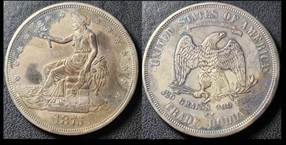
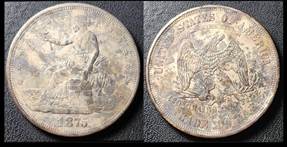
This started on December 26, 2024, when I stumbled across an eBay listing of two Trade Dollars. Both “Bodybagged” by two separate TPG services. NGC returned one as “altered surfaces” and PCGS as “questionable authenticity.” Upon reviewing the images and referencing John Coxe’s attribution guide to Trade Dollar varieties, they didn’t match any known variety.


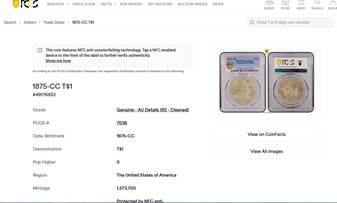
After a while of internet browsing I stumbled across a Heritage Auction listing of this previously unknown variety. After correspondence with John Coxe, I learned this new genuine variety is to be listed as the 1875cc C-17 when the SSDC site is updated as the last update was in 2022.

NGC example

PCGS example


Now to the coins! Not only did these two match a C-17 but they shared a number of circulation marks indicative of counterfeits. Interestingly both passed a sigma test for 90% silver, along with weight and dimensions being within tolerance of genuine Trade Dollars.

Sigma Metalytics test


Upon review of the obverse, I found there are a number of characteristics indicating these are struck counterfeits. I highlight three primary pickup points of the obverse to distinguish these from genuine counterparts.

  • Indentation in the denticle below the base of 1
  • Depression in the center below Liberty’s knew
  • Field depression adjacent to the star and forehead

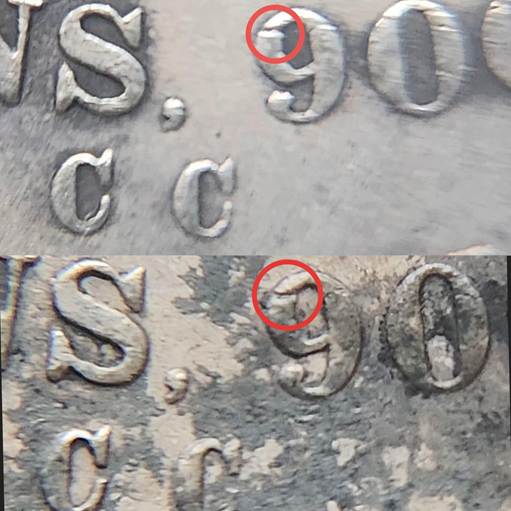
Reviewing both examples, the reverse shares a number of repeating circulation marks. However, many are minute and difficult to photograph. Primary pickups are as followed:

  • Linear depression of the 9 in “900”
  • Diagonal line through “R” in the motto

After sharing these with my friend Jack Young another example surfaced on Ebay a short time later. Now residing in a private collection it is safe from the market!


In preparation of this updated article an example surfaced on eBay certified by PCGS. This is the only example I have seen of this in an authentic TPG holder. It is noteworthy to mention the certification photo indicates it was certified in PCGS’s Chinese facility.


With only a few of these struck counterfeits being seen within the last year, it is safe to assume more exist and may already be in private collections. While the genuine variety itself appears to be scarce, it is unlikely to stumble across one of the struck counterfeits, but nothing is impossible. Actually a very easy variety to spot with CC set further right than any other variety of the date along with a hub break of the “I” of “UNITED”.

If you like posts like this, you can read more articles on counterfeit coins by Jack D. Young, Jack Riley and Michael Bugeja at this URL. Also, please subscribe so you can get our weekly newsletter and be informed whenever there is a new article or column.

Proxiblog also has thousands of followers on Facebook Coin Groups and across social media. To get the latest discussion and commentary, be sure to friend us by clicking here.

You can find more information about errors and varieties as well as buying and bidding on coins in Coin News Updated: The Essential Guide to Online Bidding. Please consider purchasing the work for yourself or a friend, as it underwrites this hobbyist website. Thank you.

AI can compose false rarity affirmation


Recently a Facebook coin group member posted a notice stating that he had found the coveted 1982-D Small Date bronze cent–verified by PCGS! Only two have been discovered, in 1916 and 1919, although social media has used the rarity to lure newbies into thinking that have the variety or that it can easily be found.

Here is what he wrote:

“This right here is for everyone that doubted me … chew that up and swallow it. no I’m not gonna be a jerk. I’m super excited. I have proved the 1982D small date with the weak D mint mark and a QDO. And a TDR it has now been verified and authenticated by PCGS as a new variety.”

He provided this proof:


Some 180 Facebook coin group members commented on his post. Here’s a snippet with Tyler Broughton noting the inconsistencies of his supposed PCGS email:


True, the person may be just hoping his submission brings the desired result. We all have been there. But what to make of the letter? It is seemingly informed and may have convinced viewers that indeed, the person did find the rarity. Many commentators congratulated him on his lottery-level find.

Without divulging his name, or the Facebook post and email, I contacted PCGS. A representative confirmed that the company would never send an email like this in advance of encapsulation. There is no Express/Gold service level. There is no Variety/Plus team (that’s NGC). Neither would it divulge internal means of certification.

Let’s take a breath.

It may be that this person indeed found a rarity. For his sake, let’s give him the benefit of the doubt. Perhaps he so believes in his diagnostics that he is sharing the good news before he gets any news. That, however, is not the point of this article. This is: How do we as hobbyists deal with a verification email that might sway us to believe that a coin, indeed, is an ultra rarity? Suppose we saw an email like this on a coin that we might want to purchase? Is this a new way to fool mhobbyists?

My answer was ChatGPT. I fed AI a few basic facts, the rarity, the date of submission, the service level and a few other details. It took me 2 minutes. Here’s what I received:


This is a chilling discovery–not of a rarity–but of how a rarity can be disguised with a fake email or letter, courtesy of AI. I won’t do this, but I could have found PCGS letterhead and pasted the above there. I could invent an email from PCGS–even with an employee name. I could no any number of things, and machine intelligence would help me.

We as hobbyists have to be on top of every new method to beguile us. This may only be the start with AI providing fictional text, video and images of our fondest numismatic desires.

If you like posts like this, subscribe so you can be informed whenever there is a new article or column.

Proxiblog also has thousands of followers on Facebook Coin Groups and other social media. To get the latest discussion and commentary, be sure to friend us by clicking here.

You can find more information about types, varieties, errors, grading, bidding and buying in Coin News Updated: The Essential Guide to Online Bidding. Please consider buying or gifting the work for a friend, as it underwrites this hobbyist blog. Thank you.

NOT NGC 1909s VDB


By Jack Riley

My daily internet browsing yields some interesting finds. Occasionally some nice varieties and of course a number of counterfeits. On my routine search of counterfeit 1909s VDB cents this example surfaced.


As we recommended to all collectors when looking at third party graded coins to always check the cert number. The cert matches an NGC authenticated example.


I shared the images with fellow Proxiblog contributor Jack Young and he made this collage image. eBay counterfeit example on the left and genuine NGC example on the right. Quoting Jack “A swing and a miss.”


So this obviously is not a genuine NGC authenticated example, nor is this a legitimate NGC holder! So one may ask “Is the coin real?” Well, no it isn’t. The images provided were very blurry and difficult to distinguish which related “family” it belonged to. What is visible and discernible is it shares a common obverse that is mismatched across the series with an indentation on Lincoln’s lapel.


The 1909-S VDB is the most counterfeited coin exported from China. In addition to fakes, they make die stuck replicas–sometimes with all die markers, sometimes not. It takes an expert eye to detect them. And as I now show, they sometimes come in NGC and PCGS fake holders.

Checking the cert is important. NGC shows photos of its slabbed coins. PCGS shows photos only if TrueView accompanies the coin. That makes China fakes in PCGS holders suspect. Often, however, the counterfeit holders lack accurate bar codes and other insignia.

The best way to guard against buying a counterfeit coin is to purchase one from a reputable dealer. Barring that, view my and Jack Young’s and Michael Bugeja’s articles on counterfeit coins published by Proxiblog.

If you like posts like this, please subscribe so you can get our weekly newsletter and be informed whenever there is a new article or column.

Proxiblog also has more than a thousand friends and followers on Facebook Coin Groups and thousands more across YouTube and social media. To get the latest discussion and commentary, be sure to friend us by clicking here.

You can find more information about errors and varieties as well as buying and bidding on coins in Coin News Updated: The Essential Guide to Online Bidding. Please consider purchasing the work for yourself or a friend, as it underwrites this hobbyist website. Thank you.